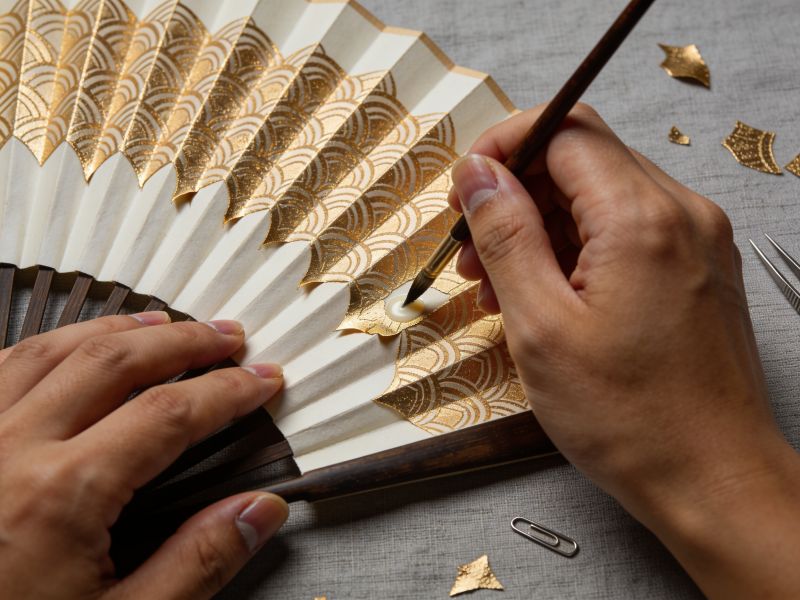
Japanese fans, or sensu and uchiwa, are far more than simple cooling devices. In a Tokyo summer, when the air hangs thick and humid, you'll see them everywhere: the rhythmic flick of a folding fan in a crowded train, the glare of a plastic uchiwa at a festival stall, the quiet elegance of a silk fan in a tea room. Each type carries centuries of craft and social meaning. The folding fan, invented in Japan during the 7th century, evolved from a ceremonial court item into a daily companion. Its folding mechanism, a series of thin bamboo ribs covered with paper or silk。allows it to collapse into a compact stick—a design so practical that it spread worldwide. But in Japan, the fan never lost its cultural weight.Walk through Kyoto's fan shops and you'll notice the specialization. A mai-ogi used in Noh theater has a specific weight and balance;a chukei for tea ceremony must open smoothly without a hint of resistance. Craftsmen spend decades perfecting the hake brush technique for painting fans, a skill passed down through families. I once watched an artisan in Kanazawa apply gold leaf to a fan's surface with a bamboo tweezers—each fleck placed with breath-holding precision. That level of detail explains why a single high-end fan can cost as much as a smartphone. It's not just a tool;it's a small canvas of regional identity. FANS FROM different prefectures use distinct papers and patterns, from the bold indigo of Awa uchiwa to the delicate chiyogami of Kyoto.Socially, Japanese fans function as silent communicators. In traditional dance, the angle of a fan can express shyness, anger, or invitation. During kabuki performances, a fan snapped shut signals a dramatic shift. Even in modern business, a folding fan left open on a desk might suggest a relaxed atmosphere, while a closed fan placed neatly indicates formality. At summer festivals, the uchiwa becomes a social prop—people fan themselves while chatting, the motion as natural as breathing. I've seen strangers at a fireworks display wordlessly share a fan's breeze。a small gesture of community. These nuances rarely make it into guidebooks, yet they define the fan's enduring role.Contemporary designers are reinterpreting the Japanese fan without abandoning tradition. Studios in Tokyo now produce fans with minimalist graphics, recycled materials, and even USB-powered fans that mimic the folding form. Some are practical: a compact fan that fits in a suit pocket, made of tear-resistant washi paper. Others are artistic statements, like fans printed with glitch art or handwritten calligraphy. The demand isn't just nostalgic. Younger generations buy them as accessories, not relics. A friend in Osaka collects fans from underground music venues—each one a memento of a concert, folded into her bag. That adaptability keeps the craft alive. Traditional artisans may grumble about cheap imports。
but the fan's core appeal—portable, beautiful, personal—remains unchanged.What strikes me most about Japanese fans is how they embody a quiet philosophy: usefulness without excess. A fan does one thing well, and it does so with grace. In an age of disposable gadgets, a well-made sensu can last generations, its paper softened by use。its ribs darkened by hand oils. That longevity feels almost rebellious. So next time you see someone flicking a fan on a sweltering day, look closer. You're watching a piece of living history, folded into a palm-sized object.